
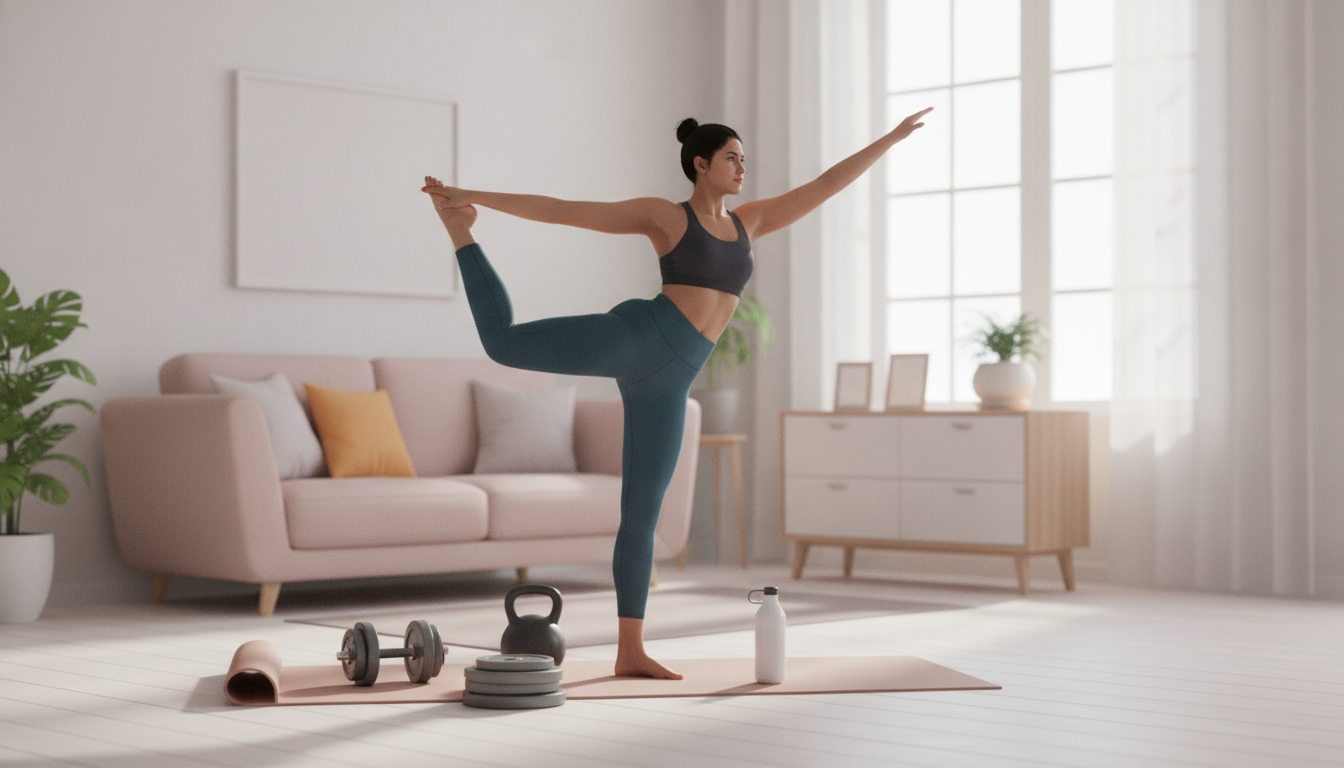
A structured four-week routine makes home training simpler: show up, follow the day’s session, and finish with a short stretch sequence. This plan focuses on full-body strength, core stability, and low-impact conditioning using minimal equipment, with clear daily workouts and recovery guidance so progress feels measurable without requiring a gym. For general activity benchmarks and safety guidance, see the Physical Activity Guidelines for Americans.
If you want a ready-to-follow layout with daily checkboxes and built-in progress notes, the Fit at Home: 4-Week Workout Plan (PDF eBook with daily workouts and stretches) keeps everything in one place.
For deeper training principles—especially how to progress safely over time—ACSM’s guidance on resistance training progression is a helpful reference: Progression Models in Resistance Training for Healthy Adults.
Use this as a consistent weekly template; difficulty increases by adding a set, a few reps, or a tougher variation each week. Warm up 5–7 minutes daily (brisk march or step-ups, arm circles, hip hinges, bodyweight squats, and light lunges). Cool down 5–8 minutes daily using the stretch flow listed later.
| Day | Focus | Main Work | Estimated Time | Stretch Emphasis |
|---|---|---|---|---|
| Day 1 | Full-body strength | Squat pattern + push + row + core | 30–40 min | Hips + chest |
| Day 2 | Conditioning + core | Intervals (low-impact options) + anti-rotation core | 20–30 min | Calves + low back |
| Day 3 | Lower body + glutes | Lunge/hinge + glute work + core | 30–40 min | Hamstrings + hip flexors |
| Day 4 | Mobility + recovery | Easy walk + mobility circuit | 20–35 min | Full-body flow |
| Day 5 | Upper body + posture | Push/pull + shoulder health + core | 30–40 min | Thoracic + shoulders |
| Day 6 | Total-body circuit | Strength-endurance circuit (moderate pace) | 25–35 min | Quads + lats |
| Day 7 | Rest or light movement | Gentle walk, easy stretching | 10–30 min | Relaxation breathing |
Choose: bodyweight squat or goblet squat; incline push-up or floor push-up; band row or backpack row; dead bug or plank. Start with 2–3 sets of 8–12 reps (planks 20–40 seconds), resting 45–90 seconds.
Do 6–10 rounds of 30 seconds work / 30 seconds easy using step jacks, fast marching, shadow boxing, or low-impact mountain climbers. Finish with 2–3 rounds of side plank (20–40 seconds/side) and bird dog (6–10 reps/side).
Pick: split squat or reverse lunge; hip hinge (Romanian deadlift with backpack/dumbbells or good morning); glute bridge or hip thrust; calf raises. Keep form strict and stop sets before technique breaks—quality beats chasing reps.
Complete 2–3 rounds of a mobility circuit: hip flexor opener, thoracic rotation, ankle rocks, and a deep squat hold (use support as needed). Add 15–30 minutes of easy walking to promote recovery and reduce stiffness.
Weekly progression ideas: add 1 set to two movements; add 2 reps per set; slow the lowering phase to 3 seconds; shorten rest by 10–15 seconds while maintaining form. For exercise variations and regressions, ACE’s movement library is a practical reference: American Council on Exercise – Exercise Library.
Comfortable training gear can also reduce distractions. Lightweight options like Boss Men’s Black Cotton Shorts are easy to move in, and supportive footwear helps on conditioning days—try D.a.t.e. Men’s Green Leather Shoes if you want a sturdy everyday pair for walking-focused sessions.
A printable, day-by-day PDF removes guesswork, helps you stay consistent, and makes progress tracking simple. The Fit at Home: 4-Week Workout Plan (PDF eBook with daily workouts and stretches) is designed to be repeated beyond the first month by following straightforward progression rules.
Most days fit into 20–40 minutes including warm-up and stretching. Strength days usually run longer than conditioning or mobility days.
Use bodyweight variations like incline push-ups, split squats, tempo squats, and isometric holds. Progress by adding reps, sets, slower tempo, or shorter rest while keeping form solid.
Keep moving with lighter intensity (walking and mobility), reduce volume for a day if needed, and prioritize sleep and hydration. Resume progression once everyday movement feels normal again.









Leave a comment